Sunday, March 7, 2010

How I ended up at Lamayuru without even trying

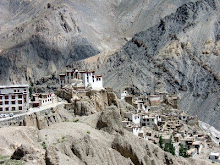
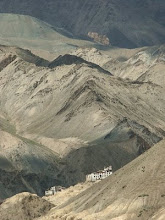
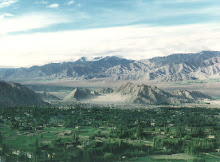
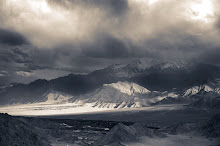
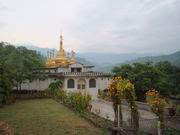
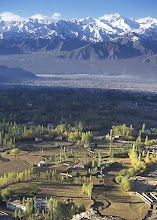
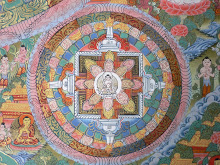
When I was young I longed for the Himalaya, and read National Geographic after National Geographic, longing especially for landscapes like this. I had a catalogue and ordered the postcard below about 20 years ago, from Snow Lion Publications in Ithaca NY. It bumped around. I put it on the refrigerator for a year or two, then stuck it in my bedroom mirror for awhile, and finally put it into a photo album of photos of my children when they were young, hoping maybe that someday someone would understand, for whatever it was worth, what landscape I always longed for, and how I lived it out, that the Tibetan Plateau and all the areas surrounding it, were where I felt I belonged. I wasn't really sure where exactly this place was, never paid much attention to the fine print on the back of the card, but assumed it was in Tibet.

I have no idea why it is I've always longed for solitude in remote regions, I would certainly imagine though, based on what I've learned in this lifetime, that there's a reason for that longing, and that it need not be questioned. Why did I dream of monks in the Himalaya, and wish I could be a calm attendant on them, by lamplight, rather than dreaming of being, say, Jacqueline Kennedy or Meryl Streep or Madame Curie? I honestly don't know. N'importe.

And then last week, a few of my children found that photo album and produced this old postcard for me to see, the one that was stuck on the refrigerator years ago.

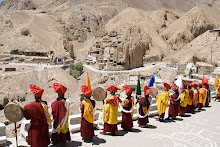
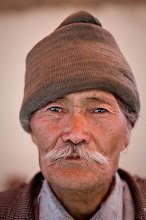
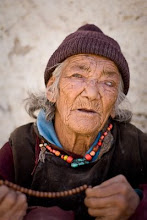
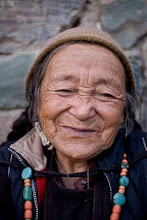
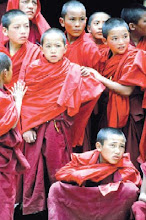
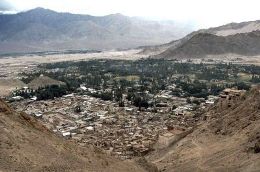
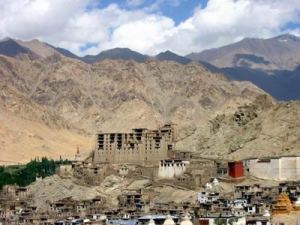
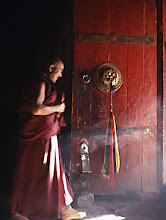
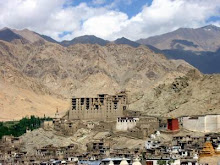
When I went to India, I decided to stay in Leh only and to be grateful for that, at my age and at that altitude. I wanted to go to Tibet, but Leh was close enough, within a hundred miles of places I had dreamed about, I figured. But by an effortless chain of events, I ended up traveling more extensively with my daughter and the NGO LEHO into more remote areas of Ladakh. I discovered recently that the postcard I bought twenty years ago, was a photo of Lamayuru Monastery, in Ladakh, India!. My daughter and I visited Lamayuru in June 08, (our driver made an unplanned detour) and witnessed the rare visit of a high-ranking monk, who arrived in a caravan of vehicles amidst all the ancient fanfare and horn-blowing of monks with precious ancient instruments, and the gathering of aged Tibetan refugees who had walked for miles and who sat curbside spinning prayer-wheels for hours....

So much happened when we were there, hours sacred and remote from earthly concerns....That day is a mystery unto itself. I could never explain it in a million years, and so it is. I was there. And not only that. It happened without me struggling for it. It happened because I just put myself in God's hand and went alone to India with no script. And then, blessing upon blessing, with my daughter, bone of my bone and flesh of my flesh, by my side. Put the picture of what you want in front of your eyes, and it may come to you!

Enough mystery for many lifetimes.


Posted by Picasa

Wednesday, February 3, 2010

George Mallory's Body: Alabaster on Everest

 
Posted by Picasa


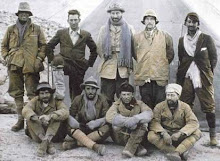
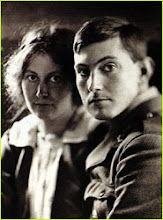
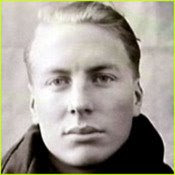
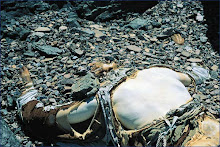
In May of 1999, when George Mallory's body was discovered frozen into Mt. Everest, the skin of his back gleaming in the sun like alabaster seventy some years after he died, I wrote a poem. I've lost the poem but I remember posting it at www.mountainzone.com, where it was absorbed into the ethers.

I had been feverishly following the Mallory-Irvine Research Expedition online, buying my kids t-shirts in support of the search, and listening with them to the reports broadcast by Eric Simonson from Everest. Conrad Anker made the find, later describing it this way:

" I saw a patch of white, that was whiter than the rock that was around and also whiter and whiter than the snow that was there, and went there. And within a few minutes of being there realized that this wasn't a body from recent times; it was something that had been there for quite awhile..... He seemed to be at peace with himself. He had been there quite awhile, and there was something very, very subtle about his being there, not really scary and violent. "


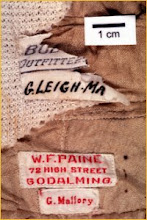
The photographs of the body were beyond thrilling to me. There's no way to express the poignancy of the image. Mallory's arms reaching upwards, his bleached white body melded to the mountain forever, his earnestness so clear even in death, trailing bits and pieces of wool and cotton clothing still, even a clearly legible name-tag sewn lovingly into his shirt. The thought that his camera might be found, and a statement by the Kodak company that they very well might be able to develop the film, was truly provocative.

How does someone tackle the likes of Mt. Everest, the high odds of death, the altitude, the weather, the strain? What shadows and forces would drive a man from the safe haven of life in Cambridge to the highest and most difficult peak in the world? He and his friend Andrew Irvine succumbed while struggling together to this peak, casting logic aside, the bond between them unfathomable to those of us ordinary mortals who lust only for what's close at hand.

Mallory was famous for responding to a reporter who asked why he wanted to climb Everest: "Because it's there." Reporters continued to ask him variations of the question again and again. "It's of no use", he said. "If you cannot understand that there is something in man which responds to the challenge of this mountain and goes out to meet it, that the struggle is the struggle of life itself upward and forever upward, then you won't see why we go. What we get from this adventure is just sheer joy. And joy is, after all, the end of life".

So to the nice woman who recently asked me what I would take along to India next week to occupy myself, and why in the world I would go to Leh ( a mere 11,000 feet) and the Tibetan plateau, I defer to Mallory, who found it hard to explain, but shut them up by saying "Because it's there."

-repeat from 6-08

Sunday, September 6, 2009

Fred Astaire and Ginger Rogers Dancing Cheek to Cheek

Is this not one of the loveliest things that ever happened on film?? Fred Astaire and Ginger Rogers in Top Hat. If you're in a hurry, skip the first two minutes, that's the singing- the dancing starts at 2 1/2 minutes. If you watch to the very end, you'll be amazed at how relaxed they are as they lean against the balcony when they glide to a close.

Saturday, May 16, 2009

Parting Words: Longfellow's Psalm of Life

In his dying days, my father quoted these lines to me from his hospital bed: the last three stanzas of Henry Wadsworth Longfellow's poem "Psalm of Life"....good for all of us to consider (and to wonder "Where have all the poets gone?" - gone to flowers, every one).


He also recited Polonius's words to Hamlet: "To thine own self be true. And it shall follow as the night the day: thou canst not then be false to any man."

He, one of the all-time-great joke tellers, also, for balance, would have been glad to tell the story about the man with the ugliest pecker in the world. But I told him we have that on tape.


A Psalm of Life

What the Heart of the Young Man Said to the Psalmist

By Henry Wadsworth Longfellow


TELL me not, in mournful numbers,
Life is but an empty dream!—
For the soul is dead that slumbers,
And things are not what they seem.

Life is real! Life is earnest!
And the grave is not its goal;
Dust thou art, to dust returnest,
Was not spoken of the soul.

Not enjoyment, and not sorrow,
Is our destined end or way;
But to act, that each to-morrow
Find us farther than today.

Art is long, and Time is fleeting,
And our hearts, though stout and brave,
Still, like muffled drums, are beating
Funeral marches to the grave.

In the world’s broad field of battle,
In the bivouac of Life,
Be not like dumb, driven cattle!
Be a hero in the strife!

Trust no Future, howe’er pleasant!
Let the dead Past bury its dead!
Act,—act in the living Present!
Heart within, and God o’erhead!

Lives of great men all remind us
We can make our lives sublime,
And, departing, leave behind us
Footprints on the sands of time;

Footprints, that perhaps another,
Sailing o’er life’s solemn main,
A forlorn and shipwrecked brother,
Seeing, shall take heart again.

Let us then, be up and doing,
With a heart for any fate;
Still achieving, still pursuing,
Learn to labor and to wait.

Saturday, May 2, 2009

Breathing Right

Maybe a few times in our life, we breathe right. Some of us know from our experience of reading random magazines and informative literature, that there are some Tibetan monks and yogis who do it right all of the time. And we know, of course, from popular wisdom, that you can do some things right all of the time and you can do some things right some of the time, but you can't do all things right all of the time. But when it comes to breathing, which we do from birth til death, wouldn't you rather be in the minority of those who have "got it down"?

Every breath we take is precious. Sometimes we hyperventilate. Sometimes we get ourselves practically comatose. We need to. We're mostly young spirits, struggling along and alone with what the law allows and with what the doctor prescribes. We stare at ourselves in the mirror at the gym, hoping to see something worthwhile. Then later we primp in front of another mirror, to prepare a face to meet the faces we will meet. We forget that we are breathing, number one.

So here's to effort. Here's to concentration. Here's to self-awareness, and those who have it. It ain't me, babe.

Wednesday, April 29, 2009

The Love Song of Alfreda Prufrock, tweaked for a woman's perspective, with apologies to T.S. Eliot

The Love Song of Alfreda Prufrock-

Let us go then, you and I,
When the evening is spread out against the sky
Like a patient etherised upon a table;
Let us go, through certain half-deserted streets,
The muttering retreats
Of restless nights in one-night cheap hotels
And sawdust restaurants with oyster-shells:
Streets that follow like a tedious argument
Of insidious intent
To lead you to an overwhelming question …
Oh, do not ask, “What is it?”
Let us go and make our visit.

In the room the gentlemen come and go
Talking of Michelangelo.

The yellow fog that rubs its back upon the window-panes,
The yellow smoke that rubs its muzzle on the window-panes
Licked its tongue into the corners of the evening,
Lingered upon the pools that stand in drains,
Let fall upon its back the soot that falls from chimneys,
Slipped by the terrace, made a sudden leap,
And seeing that it was a soft October night,
Curled once about the house, and fell asleep.

And indeed there will be time
For the yellow smoke that slides along the street,
Rubbing its back upon the window-panes;
There will be time, there will be time
To prepare a face to meet the faces that you meet;
There will be time to murder and create,
And time for all the works and days of hands
That lift and drop a question on your plate;
Time for you and time for me,
And time yet for a hundred indecisions,
And for a hundred visions and revisions,
Before the taking of a toast and tea.

In the room the sweet men come and go
Talking of Michelangelo.

And indeed there will be time
To wonder, “Do I dare?” and, “Do I dare?”
Time to turn back and descend the stair,
With my chin held high, color in my hair—
[They will say: “How that girl is growing thin!”]
My best black coat, my collar mounting firmly to the chin,
My neck scarf rich and modest, but asserted by a simple pin—
[They will say: “But how her arms and legs are thin!”]
Do I dare
Disturb the universe?
In a minute there is time
For decisions and revisions which a minute will reverse.

For I have known them all already, known them all:—
Have known the evenings, mornings, afternoons,
I have measured out my life with coffee spoons;
I know the voices dying with a dying fall
Beneath the music from a farther room.
So how should I presume?

And I have known the eyes already, known them all—
The eyes that fix you in a formulated phrase,
And when I am formulated, sprawling on a pin,
When I am pinned and wriggling on the wall,
Then how should I begin
To spit out all the butt-ends of my days and ways?
And how should I presume?

And I have known the arms already, known them all—
Arms that are muscled and tan and bare
[And in the lamplight, slung strong behind my chair!]
Is it remembering men getting dressed
That makes me so digress?
Arms that reach across the table, or help me wrap my shawl.
And should I then presume?
And how should I begin?
. . . . .
Shall I say, I have gone at dusk through narrow streets
And watched the steam that rises from the pots
Of lonely women's soups, drifting fragrant out of windows?…

I should have been a pair of ragged claws
Scuttling across the floors of silent seas.
. . . . .
And the afternoon, the evening, sleeps so peacefully!
Smoothed by strong fingers,
Asleep … tired … or it malingers,
Stretched on the floor, here beside you and me.
Should I, after tea and cakes and ices,
Have the strength to force the moment to its crisis?
But though I have wept and fasted, wept and prayed,
Though I have seen my head [a head grown old] brought in upon a platter,
I am no prophetess—and here’s no great matter;
I have seen the moment of my greatness flicker,
And I have seen the eternal Footman hold my coat, and snicker,
And in short, I was afraid.

And would it have been worth it, after all,
After the cups, the marmalade, the tea,
Among the porcelain, among some talk of you and me,
Would it have been worth while,
To have bitten off the matter with a smile,
To have squeezed the universe into a ball
To roll it toward some overwhelming question,
To say: “I am a goddess, come from the dead,
Come back to tell you all, I shall tell you all”—
If one, settling a pillow by his head,
Should say: “That is not what I meant at all.
That is not it, at all.”

And would it have been worth it, after all,
Would it have been worth while,
After the sunsets and the dooryards and the sprinkled streets,
After the novels, after the teacups, after our skirts that trailed along the floor—
And this, and so much more?—
It is impossible to say just what I mean!
But as if a magic lantern threw the nerves in patterns on a screen:
Would it have been worth while
If one, settling a pillow or throwing off a shawl,
And turning toward the window, should say:
“That is not it at all,
That is not what I meant, at all.”
. . . . .
No! I am neither prophetess nor queen, nor was meant to be;
Am an attendant lady, one that will do
To swell a progress, start a scene or two,
Advise the queen; no doubt, an easy tool,
Deferential, glad to be of use,
Politic, cautious, and meticulous;
Full of high sentence, but a bit obtuse;
At times, indeed, almost ridiculous—
Almost, at times, the Fool.

I grow old … I grow old …
I shall wear the tops of my stockings rolled.

Shall I pull my hair behind? Do I dare to eat a peach?
I shall wear white linen pants, and walk upon the beach.
I have heard the seagods singing, each to each.

I do not think that they will sing to me.

I have seen the sea-gods riding seaward on the waves
Stirring the white peaks of the waves blown back
When the wind blows the water white and black.

We have lingered in the chambers of the sea
By sea-gods wreathed with seaweed red and brown
Till human voices wake us, and we drown
~~~~~~~~~~~~


With my apologies to the purists - TC

Saturday, April 25, 2009

Remembering 1918 influenza, and the 1976 swine flu shot, hoping for immunity

I have tried to explain to my kids that I am old enough to remember hearing stories from people who survived the 1918 pandemic influenza that killed FIFTY MILLION people worldwide. My mother's brother died as an infant then. My mother hadn't been born yet, but two older brothers had contracted the virus. Doctor Jacquish came and tended to the family through long winter's nights. He finally had to ask my grandmother to choose between two sons, the infant or the four-year old, because he had to work continuously to keep either child breathing, siphoning off fluids etc,...and couldn't tend to both. My brokenhearted grandmother had to make her choice, and she chose the four year old because, she said, she knew him better, and he knew life better. In her eyes, the baby would be welcomed back and restored to health by the angels he had so recently left. And so it was.

Noone knows what lies ahead. People don't want to hear, and can't believe, that such long winter's nights as my grandmother's could happen again, to them. I'm scared. I have listened for years to old scientists predicting with fearful confidence that another pandemic is coming. I hope this isn't it. But there's hope. I was vaccinated reluctantly in 1976 against a swine flu, along with about 25% of the U.S. population. That turned out to be a fiasco, which caused Guillaine- Barre syndrome in some people, against an outbreak that never materialized. My father, the doctor who gave the shot to my mother, my sister and me in our living room, always said those who developed that syndrome were hypochondriacs, though I swear I was never the same after that shot. But I've decided, using my ever-active-imagination, that maybe there's an upside.

Here's hoping that it's not illogical to think that that controversial immunization may have provided some protection to those who received it, and, through subsequent pregnancies and lactation, to children who are now young adults in the at-risk age group. Since I have five children in that demographic, I'm going with that.

Thursday, April 23, 2009

Measuring out Life With Coffee Spoons, at last

I do understand so well
Now that I've lived through many moons
What TS Eliot meant by
life measured out in coffee spoons.

Each morning when I stumble downstairs
And barely have strength to move
I know that the coffee will help
And I measure that stuff with love.

Some days the filter’s still full
With the grounds of the day before
So I grumble and moan and rinse
And fill the gruesome filter once more

I measure generously with a spoon
That I have had for thirty years
I know just how to fill it and hold a high hump
No other spoon soothes my fears

that I won't have strong coffee
That I’m really alive
That I’ve slept through another night -
And risen again to go out and work:
It generally works out right.

Usually I remember to clean out the filter
And dry it the day before.
And, as I’ve said,
Sometimes I forget.
I’ll do this forevermore.

But how many more times?
And how many more spoonfuls
Of coffee will I measure out?
How many more cans
of Folgers Columbian
will I slobber into my snout?

My coffee and me
We’ll never part
I’ll never subdue to tea.
I’ll measure and filter and whimper til death
Yeah, T.S. Eliot and me.

"Fifty Years Seems But A Day"

I just can't begin to imagine
how the folks in the world
got so young.
It was only a quarter to seven
when I myself turned twenty-one.

But that clock is in some clock heaven
a gold watch my father gave me -
It was, (Lord!) nineteen-sixty-seven
when he made me that great martini.

And then there's a blur
and a swishing of years
and I swear that it didn't take long
To watch the world age
and decay and implode,
dragging little young me along.

I remember my grandma said once in the sun
as she brushed hair long since gone gray:
"When I think of my youth and my mother and friends,
Fifty years seems but a day."

Wednesday, April 1, 2009

Equilibrium, Life is Good: To Hell with Murphy's Law

I'm not so sure that when all is said and done, I'd be proud to be the person who created Murphy's Law.I mean you would have to be young hot and glamorously cynical to come up with stuff like that. Sure, all that stuff is true some of the time: "Anything that can go wrong will go wrong." "Enough research will tend to support your theory". So who doesn't know that riff already? Who doesn't know that, sometimes at least, life seems that way? Only someone who hasn't been around the block much, or at least, read much research. But when you grow old, and your life is fading away - you were smart enough to have been cynical and flip at times- and, looking back, you know you could have have done better. So is something like "Murphy's Law" really the imprimatur you'd want to leave behind?

I'd much rather be the person who created a theory that gave people hope. Even old Mr. Murphy, on his deathbed, must have thought: "I was smart. I could have come up with something a little better, a little more helpful to all those who will come after me. I wish I would have used my wits, and become famous for saying something like "All sentient beings seek equiibrium." "True equilibrium is finally achieved only in death." Or better yet,"All things are possible if you will only believe."

Saturday, March 28, 2009

Throat Singing Saturday Night

Well it's not exactly Jukebox Saturday Night, but here's what you can do, even ye of little faith: Listen to the Gyuoto Monks Tantric Choir, let's say "Tantric Chants for World Peace".....don't be scared of the word "tantric"- it's not all about exotic sexual positions that you're afraid you can't do...it's nothing like that. It's just something you should listen to...and carry on...steer the ship, cook dinner, tend the baby, phone your mother....just carry on, and let the music insinuate itself into your innermost reaches. Don't worry. Don't even try. Just carry on. Mickey Hart of the Grateful Dead made this recording possible, so let's be grateful to him.

This music is dying out. Very few people can do it. Try singing from a whole bunch of places in your throat, all at the same time. It takes training, it's beyond most people's imaginings. Some Tibetan chanting makes use of musical instruments such as the human skull of a past master. This is not whimsical stuff. It resonates in your flesh and bones. As you listen carefully, (and sometimes it's so discordant that it really hurts), lifetimes resolve, dissolve, revolve, evolve. Concentrate. "He who has ears to hear, let him hear."

A 30 second sample:

Wednesday, December 10, 2008

Patience With Others: Dalai Lama and Confucius

I love getting my weekly Dalai Lama quotes in the email, and I particularly love this quote about the impossibility of transference of inner development from one person to another. (If more people understood this, it would be easier for teachers and parents to accept each child's uniqueness.) But Chinese thought offers a gentle counterbalance in the I Ching, about how the force of a good strong personality can influence even the most stubborn people for the better: one of my favorite Hexagrams, 61, Inner Truth.


Dalai Lama Quote of the Week from Snow Lion Publications:

"...when you start practicing, you should not expect too much. We live in a time of computers and automation, so you may feel that inner development is also an automatic thing for which you press a button and everything changes. It is not so. Inner development is not easy and will take time. External progress, the latest space missions and so forth, have not reached their present level within a short period but over centuries, each generation making greater developments based on those of the previous generation. However, inner development is even more difficult since internal improvement cannot be transferred from generation to generation. Your past life's experience very much influences this life, and this life's experience becomes the basis for the next rebirth's development, but transference of inner development from one person to another is impossible. Thus, everything depends on yourself, and it will take time.

I have met Westerners who at the beginning were very enthusiastic about their practice, but after a few years have completely forgotten it, and there are no traces of what they had practiced at one time. This is because at the beginning they expected too much. Shantideva's Engaging in the Bodhisattva Deeds emphasizes the importance of the practice of patience--tolerance. This tolerance is an attitude not only towards your enemy but also an attitude of sacrifice, of determination, so that you do not fall into the laziness of discouragement. You should practice patience, or tolerance, with great resolve. This is important."

--from Kindness, Clarity, and Insight 25th Anniversary Edition by The Fourteenth Dalai Lama, His Holiness Tenzin Gyatso, edited and translated by Jeffrey Hopkins, co-edited by Elizabeth Napper, published by Snow Lion Publications
~~~~~~~~~~~~~~~~~~~~~~~~~~~~~~~~~~~~~~~~~~~~~~~~~~~~~~~~~~~~~~~~~~~~~~~~~~
Now for the gentle counterbalance from the I Ching, Hexagram 61, Inner Truth:

Chung Fu / Inner Truth
above SUN THE GENTLE, WIND
below TUI THE JOYOUS, LAKE

"The wind blows over the lake and stirs the surface of the water. Thus visible effects of the invisible manifest themselves. The hexagram consists of firm lines above and below, while it is open in the center. This indicates a heart free of prejudices and therefore open to truth. On the other hand, each of the two trigrams has a firm line in the middle; this indicates the force of inner truth in the influences they represent.

The attributes of the two trigrams are: above, gentleness, forbearance toward inferiors; below, joyousness in obeying superiors. Such conditions create the basis of a mutual confidence that makes achievements possible.

The character of fu ("truth") is actually the picture of a bird's foot over a fledgling. It suggests the idea of brooding. An egg is hollow. The light-giving power must work to quicken it from outside, but there must be a germ of life within, if life is to be awakened. Far-reaching speculations can be linked with these ideas.
The Judgment

利 貞 利 涉 大 川 豚 魚 吉 中 孚

INNER TRUTH.

Pigs and fishes.
Good fortune.
It furthers one to cross the great water.
Perseverance furthers.

Pigs and fishes are the least intelligent of all animals and therefore the most difficult to influence. The force of inner truth must grow great indeed before its influence can extend to such creatures. In dealing with persons as intractable and as difficult to influence as a pig or a fish, the whole secret of success depends on finding the right way of approach. One must first rid oneself of all prejudice and, so to speak, let the psyche of the other person act on one without restraint. Then one will establish contact with him, understand and gain power over him. When a door has thus been opened, the force of one's personality will influence him. If in this way one finds no obstacles insurmountable, one can undertake even the most dangerous things, such as crossing the great water, and succeed.

But it is important to understand upon what the force inner truth depends. This force is not identical with simple intimacy or a secret bond. Close ties may exist also among thieves; it is true that such a bond acts as a force but, since it is not invincible, it does not bring good fortune. All association on the basis of common interests holds only up to a certain point. Where the community of interest ceases, the holding together ceases also, and the closest friendship often changes into hate. Only when the bond is based on what is right, on steadfastness, will it remain so firm that it triumphs over everything."

Sunday, November 30, 2008

Ted Turner Sings "Home on the Range" on Meet the Press

I will post Ted Turner's very sweet and unadorned rendition of "Home on the Range" as soon as it's on Youtube.

I love Ted Turner and would go so far as to say I understand him. But that's only thanks to Tom Brokaw's questioning of him tonight on Meet the Press, and casual but steady observations of him through the years. I haven't even read his latest book, "Call Me Ted", but I look forward to it. Maybe I've been bamboozled. I thought before tonight that the conventional wisdom was that he was a jerk. But there's just no way, not based on what I just saw on Meet the Press.

He's no Donald Trump. that's for sure. The Donald lays it all out on the table for show and razzle-dazzle, a really fun snake-oil salesman. Ted Turner is just Ted Turner, laying out only what he wants, and most gently at that. On tonight's show, Mr. Brokaw discussed the troubled relationship Mr Turner had with his father, who never thought his son Ted would amount to anything because he was studying Classics at Brown. Ted answered, barely changing his expression, honestly and forthrightly, that his father's disapproval and subsequent suicide eventually made him a better person. He learned to keep on going and to set his lifetime goals impossibly high so that he would never lose energy or motivation. The man has done so much, and given so generously, to make the world, the WORLD, mind you, a better place. He allowed himself to beam just a little with pride when he talked about giving the U.S. government a bailout when they were "coming up short".

His interesting comment in response to Brokaw's question asking if Putin has kind of "a KGB look" was basically "Hey, they have a KGB, we have an FBI, both respectable organizations." Who knew? But I'd wager Ted Turner knows more about that than I do.

Then Mr. Brokaw read a statement from Jane Fonda about how Ted can't "open himself" to religion or the Holy Spirit. Hogwash! No wonder they couldn't stay married! What could she, with all her ups and downs, insecurities and "right ideas", know for sure about the inner workings of someone so private, humble and steady? (I'm under a spell.)

"Ted Turner!? Humble!?", you say? I'd say yes. In response to Mr. Brokaw's question about whether he prayed, Mr. Turner replied that he prayed for his friends when they were ill, but that he tried to keep the prayers short so as not to clog the airwaves.

And then, at Tom Brokaw's request,and because they are apparently friends, Ted Turner closed by singing one verse a capella, without the chorus, of "Home on the Range." It was lovely.

Ineffable Experience at Lamayuru


Raum Feur
Posted by Picasa

Ineffable Experience at Lamayuru

My daughter Honna and I actually saw this happen in Lamayuru! We were there when the photos above were taken. It was not a large group of people, it was a more-or-less private celebration by the monks and local Buddhists to welcome a visitor, a monk supposedly very close in rank to the Dalai Lama. We stood with the group as banners waved and the monks' hauntingly beautiful instruments and horns resounded across the valleys. We watched the progression towards us of the monk, travelling in a caravan of white Jeep-type vehicles toward the monastery. We were not forewarned, and thought we were only visiting for a quick look at the monastery on our way to Domkhar to view the LEHO projects and the Women's Alliance Group. But our host surprised us by asking casually if we would be interested in taking a little detour and visiting Lamayuru. We had tea and soup at a cavernous cafe there at the monastery, and noticed monks tending to instruments and donning robes and headgear casually here and there, as if getting ready to go to a band practice. - (I think some of the cool looking guys in cargo pants and t-shirts who were working in the cafe morphed into the transcendent figures on the mountaintop, all the better)- We barely sensed the growing anticipation at the monastery, because the "vibe" was so cool, calm and collected.
Posted by Picasa

Travels on the Leh-Srinigar Road and Beyond

This is a post from July 08 which I have dug out because it's about my trip with my daughter through Jammu and Kashmir, specifically Ladakh. For some reason it was still in the "edit" column and I apparently never published it to the blog. But in light of recent horrors in Mumbai, which some analysts attribute to disputes over Kashmir, it seems timely to describe some of the beauties of the area which we experienced. If you scroll down to late July and early August (click on "older posts"), there are many photos of this trip, still not 100% organized, but enough to give you a feel for this magnificent part of the world.
~~~~~~~~~~~~~~~~~~~~~~~~~~~~~~~~~~~
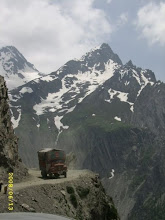
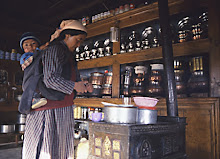
Cannot believe the wonderful trip we took with Mr. Tashi from LEHO...the vehicle was small and the LEHO people, Dr. Mohammed Deen and Razia Sultana were so helpful in making the arrangements, which involved helping to transport LEHO-connected people from one town to another. They were all concerned if we would be uncomfortable. "Oh no it'll be fine" I said, little knowing what a full spectrum of comfort levels there are in this world, and in particular along the Leh-Kargil road.....so arduous but so incredible. The engineering feat of creating this wonderful road, with its stone walls, so much of it in excellent shape, is an endeavor most Americans couldn't imagine....the workers live in tents along the way, working for months at a time before taking breaks to go home to their villages.

Everywhere we went the hospitality was so generous, kind, gentle. My photos, if I ever get rested enough to upload them, will confirm the utter beauty of the homes and the hard work the people do with ease and love. We slept in a tent on the top of a Ladakhi roof in the village of Dumkbar. If we would have done any sleepwalking outside the tent we would have fallen off a ledge into oblivion. I usually go to the bathroom several times a night but this was definitely not an option...the toilet would have required a trip down stairs through the home where people were sleeping, and then outside along a narrow path through a garden.I t was what they call a dry toilet which is a hole in the ground. The toilet was not the problem, just the location of it, one misstep in the nighttime could have ended in disaster. At the home we were staying it was very clean, everything was clean and beautiful, shrines and holiness throughout.

The ride was so harrowing and backbreaking I can't believe the fascinating things that happened along the way and the people we met and all that we learned. I would do it all again tomorrow if I had a chance.

Unfortunately Honna's camera memory card of the trip got scratched and so much of it all is lost we think. It's a true heartbreak. But we have to accept it and move on. We still have enough to design the brochure that LEHO needs, since they acknowledge forthrightly their weakness is in written English documentation of their work. They do have a logo but I think it needs help. They appoint the head of their greenhouse projects in each village and then provide materials and training for start-up, but then back off, and let the villagers run it themselves, dropping in now and then to offer help without insulting the pride of the villagers. Everyone profits, and everyone must pay some money into their business, machine repairs etc. We also visited a self-starting children's school that runs for an hour each night, at 7:30 after work is done, just to learn one English word a day. I will look for flash cards with pictures on the baclk to send them. Also it amazes me that they apparently don't grow or know about kale, which loves the winter. so I'm going to send some seeds.... The winters are so hard and these LEHO projects are designed in conjunction with 4 other NGOS to help improve the villagers life.

We just happened to be present at Lamayuru monastery when a new Rimpoche arrived for a visit in a caravan of modern white jeeps.We saw them weaving back and forth across the mountains from a long way off. All the monks played their ancient instruments and wore the ancient ceremionial garb for the arrival, the most ancient Ladakhis and Tibetan refugees in traditional garb spun prayer wheels and sat along the road, waiting for him. I don't know how they have the strength to walk so far and up such hills. We also visited Alchi monastery, absolutely impossible to describe the ancient beauties, efforts, and mysteries there. These monasteries have as much and maybe more spiritual oomph than anywhere I've ever been. When you consider how remote they are, how difficult they are to reach even in 2008, you really do have to wonder how they could build gilded statues of Buddhas encrusted with semi-precious stones two stories high- a thousand years ago!

But most importantly perhaps, we saw the LEHO (NGO) works in progress, microhydroelectric power in action for grinding almonds, extracting the oil, and grinding barley. The community all benefits from each product through a cooperative unit, with the European Union at the top of the pyramid of engineers and donors. No USA support of LEHO to speak of yet, but we will research that and set up a fund for interested donors. Swedish and French very large donors of equipment including weaving looms, spinning and wool carding machines. I bought one shawl that will supposedly support a village for a long time, and empower women to have their own money. Many of the projects are arranged so that the women don't have to ask their husbands for money for household expenses, which is considered to be humiliating.

We were entertained in every household we visited- every greenhouse, every root cellar, every poultry farm, every apricot drying scheme, every garden, by kind gracious, gentle, laughing, happy people, offering us butter tea and regular tea and biscuits and very crunchy almond barley mix...We rode much of the journey with traditionally dressed Ladakhi women, sleeping on one another's shoulders etc as we bumped along.

I hadn't realized the importance of the slight change in altitude and keeping hydrated for the return to Leh, which is higher altitude. Last night I had my first episode of true frightening death-defying pain, getting an hourlong headache in which I thought my brain was exploding. Never in my life experienced such pain, it was beyond belief. Honna did her kind care and pranic healing, and just her kind hand on my brow and to be able to hold onto her arm was such a comfort. I couldn't get out of bed for another twelve hours as it subsided. I thought it was cerebral edema (for which I had brought an emergency supply of predisone but didn't use) but Honna softly and gently said not to worry, it was just lack of proper hydration on our journey. The Ladakhi women don't drink water on their journeys so I was trying to be one of them and not be so American with my water bottle, but I am what I am, and the water is so critical at altitude..you have to drink it all day long from safe water bottles, everyone does, plastic which can be refilled at certain places, but plastic in general is frowned upon in this most ecologically aware part of the world...they put America to shame here in Ladakh, because their ecological schemes are so advanced and so gentle...

On the way back we were nearly out of gas and it was very dark on very windy roads along cliffs. We saw ancient remote statues - gilded and bejewelled- of various deities in the temples along the way. Even though it's only a few hundred kilometers to Dumkbar along the Srinigar-Leh road, it took about eight hours with all our stops along the way. It was a hard and exhausting journey but when we arrived, and sat on a dirt floor by candlelight with the beautiful men and women, looking at their cooperative efforts in handicraft, and drinking butter tea sitting by the looms and woolens and grains, helping to box them up to take to market the next day, it was an ineffably beautiful end to the day. In the car the next day the ever-jolly Ladakhi women took turns grabbing my thigh and shaking it and saying how strong I was and how young I look! I have a hard time accepting compliments, but it is amazing and shocking to get compliments from the people I admire most in the world for their strength and beauty. However life in the mountain villages is hard, and people whose age I estimate as 60 or 70 are actually only in their forties and fifties, but still beautiful beyond words....

I am beyond happy, beyond blessed,beyond wonder, so full of gratitude for this experience....Love to all...Please become aware of Ladakh. Honna and I will be trying to raise awareness in the USA when we return. As I've said, we are responsible now for making a brochure and other literature as part of our arrangement with the NGO LEHO to go to the outer villages and homes.ALthough Leh is a wonderful bustling tourist destination with its share of hustlers and vendors just like any other tourist town, Ladakh is an unspoiled, almost unspoilable region of the world. I haven't been able to upload photos, the time is too long, but no picture could ever capture the pure goodness and beauty of Ladakh.

Tuesday, November 18, 2008

Wasting Some Time Staring at the Stars

I was supposed to be in bed already, work tomorrow and all that. But I grabbed a bag of granola and started staring out the windows looking at the stars, and wondering about the universe. WHAT IS IT THAT WE HOPE IS OUT THERE?

I imagined someone like me, light years away, starting to grow old, tired and feeling lazy, holding onto a granola cereal bag and staring at her sky, wondering what her children are doing and whatever happened to the men she loved in her life,,,,munching away and staring at some distant planet that might be earth, and imagining that maybe it's better here,and in her helpless kindness, wishing us well.

Tuesday, November 11, 2008

George Mallory's body: Alabaster on Everest

 
Posted by Picasa


In May of 1999, when George Mallory's body was discovered frozen into Mt. Everest, the skin of his back gleaming in the sun like alabaster seventy some years after he died, I wrote a poem. I've lost the poem but I remember posting it at www.mountainzone.com, where it was absorbed into the ethers.

I had been feverishly following the Mallory-Irvine Research Expedition online, buying my kids t-shirts in support of the search, and listening with them to the reports broadcast by Eric Simonson from Everest. Conrad Anker made the find, later describing it this way:

" I saw a patch of white, that was whiter than the rock that was around and also whiter and whiter than the snow that was there, and went there. And within a few minutes of being there realized that this wasn't a body from recent times; it was something that had been there for quite awhile..... He seemed to be at peace with himself. He had been there quite awhile, and there was something very, very subtle about his being there, not really scary and violent. "


The photographs of the body were beyond thrilling to me. There's no way to express the poignancy of the image. Mallory's arms reaching upwards, his bleached white body melded to the mountain forever, his earnestness so clear even in death, trailing bits and pieces of wool and cotton clothing still, even a clearly legible name-tag sewn lovingly into his shirt. The thought that his camera might be found, and a statement by the Kodak company that they very well might be able to develop the film, was truly provocative.

How does someone tackle the likes of Mt. Everest, the high odds of death, the altitude, the weather, the strain? What shadows and forces would drive a man from the safe haven of life in Cambridge to the highest and most difficult peak in the world? He and his friend Andrew Irvine succumbed while struggling together to this peak, casting logic aside, the bond between them unfathomable to those of us ordinary mortals who lust only for what's close at hand.

Mallory was famous for responding to a reporter who asked why he wanted to climb Everest: "Because it's there." Reporters continued to ask him variations of the question again and again. "It's of no use", he said. "If you cannot understand that there is something in man which responds to the challenge of this mountain and goes out to meet it, that the struggle is the struggle of life itself upward and forever upward, then you won't see why we go. What we get from this adventure is just sheer joy. And joy is, after all, the end of life".

So to the nice woman who recently asked me what I would take along to India next week to occupy myself, and why in the world I would go to Leh ( a mere 11,000 feet) and the Tibetan plateau, I defer to Mallory, who found it hard to explain, but shut them up by saying "Because it's there."

-repeat from 6-08