The breaking news from stem cell researchers in Japan and Wisconsin is comparable to the coming of the Christ for me. It has nothing to do with the ethical debate George Bush pretended to monitor. It's not that now all the politicians can breathe a sigh of relief. It's simply that skin cells can be transformed into performers of embryonic stem cell functions. This morning's report on msnbc says that skin cells, when mixed with just a few genes, could theoretically be changed into sperm and egg cells."But nobody is planning on doing that."
Fair enough. Obviously the science here is beyond most of us, and I, a ramshackle thinker, have absolutely no idea how they come upon these things. But we can grasp it, through a glass darkly, with a dim understanding that can be thrilling. Think about it for a minute. The most far-reaching implication is that a few microscopic cells could be ultimately reconstituted into a human being, a clone of sorts, you again? Doesn't this also have implications for the support of theories of reincarnation and eternal life? Dust to dust, ashes to ashes. And then a few lingering cells in those ashes become.... you again!?
I've been blessed since childhood, brought up in the way I should go. I have seldom doubted that there is eternal life, that there is world upon world, "more things than are dreamt of in your philosophy, Horatio". I was always thrilled by the words "In my father's house are many mansions, if it were not so I would have told you." and "He who has ears to hear, let him hear." I've never been too concerned about clinging to my body or having it again in some earth-clone eternal kingdom. I do believe though in the communion of saints and the life everlasting. Mysteries abound.
I've been searching frantically this morning for a passage from Annie Dillard regarding Job and God's conversation about the foundations of the world. God asks Job "Where were you when I created the foundations of the earth?" Annie Dillard says Job should have said "I was there, God, I was there!" Because we are made from the very stuff of stars, we are part and parcel of the heavens, we are part of the thread of life that is made from bits and pieces of eternity. How could it be otherwise?
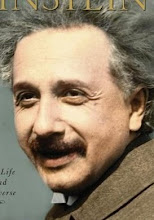
Didn't Einstein posit that energy can be neither created nor destroyed? So there's nowhere for us to go, except right here in the universe forever. Little bits of us are sloughed off every day as we go about our daily tasks. DNA can be retrieved from a hairbrush or a computer keyboard. We're leaving little bits everywhere. Everything is changing and moving and shifting and blowing. Who knows what wonders God hath wrought?
Showing posts with label Einstein. Show all posts
Showing posts with label Einstein. Show all posts
Wednesday, November 21, 2007


Tuesday, November 13, 2007
Feeling Smart: A Bertrand Russell Primer
If you’re anything like me, your bookcase was bejeweled at some point in the last twenty years with a copy of Stephen Hawking’s “A Brief History of Time.” Mine sat around bedside for awhile, then made its way to the coffee table for admiration purposes, and finally to the bookshelf where it is presently covered with ashes from the fireplace, fallen bits of incense and what look to my overactive imagination like they might be bat droppings.
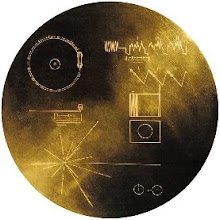
We can all understand why we bought the book. It was affordable and fairly small. The cover photograph was compelling: Stephen Hawking under the stars in his wheelchair, his Einstein-ishness fascinating in the context of his disability. And the eminently user-friendly Carl Sagan wrote an introduction! (You haven’t forgotten him, and that plaque he sent out into the heavens, the Voyager Golden Record, have you?) But above all, we bought the book because it made us feel smart. For a moment, we thought we might actually be able to understand it. Mine looked very good up against my copy of “The World Treasury of Physics, Astronomy, and Mathematics.” And of course, we wanted a little of it to rub off on our kids.
Bertrand Russell, the British philosopher and mathematician who died in 1970 at nearly 100 years old, is just as formidable an intellect as Mr. Hawking, by my simple figuring. And, with all due respect to Mr. Hawking, more so, because he had such broad ranging impact. Russell co-authored “Principia Mathematica” and wrote “History of Western Philosophy.” Above and beyond his achievements in mathematics and philosophy, he was active in opposing the Vietnam War and nuclear armament, and he won the Nobel Prize in Literature in 1950.
His autobiography is a little dry but quite readable. And I assure even the most hesitant reader that you can share, understand and cherish some of this brilliant man’s deepest thoughts, and you'll feel mighty smart when you do. He elevates us with his eloquence. You need only read the following few beautiful paragraphs - the prologue to his autobiography- and I know that you may be moved, as I was, forever. Then add a supersmart book to your library that you can reach for, knowing of a page you can read to the kids.
THE PROLOGUE TO BERTRAND RUSSELL'S AUTOBIOGRAPHY
"WHAT I HAVE LIVED FOR"
“Three passions, simple but overwhelmingly strong, have governed my life: the longing for love, the search for knowledge, and unbearable pity for the suffering of mankind. These passions, like great winds, have blown me hither and thither, in a wayward course, over a great ocean of anguish, reaching to the very verge of despair.
I have sought love, first, because it brings ecstasy - ecstasy so great that I would often have sacrificed all the rest of life for a few hours of this joy. I have sought it, next, because it relieves loneliness--that terrible loneliness in which one shivering consciousness looks over the rim of the world into the cold unfathomable lifeless abyss. I have sought it finally, because in the union of love I have seen, in a mystic miniature, the prefiguring vision of the heaven that saints and poets have imagined. This is what I sought, and though it might seem too good for human life, this is what--at last--I have found.
With equal passion I have sought knowledge. I have wished to understand the hearts of men. I have wished to know why the stars shine. And I have tried to apprehend the Pythagorean power by which number holds sway above the flux. A little of this, but not much, I have achieved.
Love and knowledge, so far as they were possible, led upward toward the heavens. But always pity brought me back to earth. Echoes of cries of pain reverberate in my heart. Children in famine, victims tortured by oppressors, helpless old people a burden to their sons, and the whole world of loneliness, poverty, and pain make a mockery of what human life should be. I long to alleviate this evil, but I cannot, and I too suffer.
This has been my life. I have found it worth living, and would gladly live it again if the chance were offered me.”
-Bertrand Russell
We can all understand why we bought the book. It was affordable and fairly small. The cover photograph was compelling: Stephen Hawking under the stars in his wheelchair, his Einstein-ishness fascinating in the context of his disability. And the eminently user-friendly Carl Sagan wrote an introduction! (You haven’t forgotten him, and that plaque he sent out into the heavens, the Voyager Golden Record, have you?) But above all, we bought the book because it made us feel smart. For a moment, we thought we might actually be able to understand it. Mine looked very good up against my copy of “The World Treasury of Physics, Astronomy, and Mathematics.” And of course, we wanted a little of it to rub off on our kids.
Bertrand Russell, the British philosopher and mathematician who died in 1970 at nearly 100 years old, is just as formidable an intellect as Mr. Hawking, by my simple figuring. And, with all due respect to Mr. Hawking, more so, because he had such broad ranging impact. Russell co-authored “Principia Mathematica” and wrote “History of Western Philosophy.” Above and beyond his achievements in mathematics and philosophy, he was active in opposing the Vietnam War and nuclear armament, and he won the Nobel Prize in Literature in 1950.
His autobiography is a little dry but quite readable. And I assure even the most hesitant reader that you can share, understand and cherish some of this brilliant man’s deepest thoughts, and you'll feel mighty smart when you do. He elevates us with his eloquence. You need only read the following few beautiful paragraphs - the prologue to his autobiography- and I know that you may be moved, as I was, forever. Then add a supersmart book to your library that you can reach for, knowing of a page you can read to the kids.
THE PROLOGUE TO BERTRAND RUSSELL'S AUTOBIOGRAPHY
"WHAT I HAVE LIVED FOR"
“Three passions, simple but overwhelmingly strong, have governed my life: the longing for love, the search for knowledge, and unbearable pity for the suffering of mankind. These passions, like great winds, have blown me hither and thither, in a wayward course, over a great ocean of anguish, reaching to the very verge of despair.
I have sought love, first, because it brings ecstasy - ecstasy so great that I would often have sacrificed all the rest of life for a few hours of this joy. I have sought it, next, because it relieves loneliness--that terrible loneliness in which one shivering consciousness looks over the rim of the world into the cold unfathomable lifeless abyss. I have sought it finally, because in the union of love I have seen, in a mystic miniature, the prefiguring vision of the heaven that saints and poets have imagined. This is what I sought, and though it might seem too good for human life, this is what--at last--I have found.
With equal passion I have sought knowledge. I have wished to understand the hearts of men. I have wished to know why the stars shine. And I have tried to apprehend the Pythagorean power by which number holds sway above the flux. A little of this, but not much, I have achieved.
Love and knowledge, so far as they were possible, led upward toward the heavens. But always pity brought me back to earth. Echoes of cries of pain reverberate in my heart. Children in famine, victims tortured by oppressors, helpless old people a burden to their sons, and the whole world of loneliness, poverty, and pain make a mockery of what human life should be. I long to alleviate this evil, but I cannot, and I too suffer.
This has been my life. I have found it worth living, and would gladly live it again if the chance were offered me.”
-Bertrand Russell
Subscribe to:
Posts (Atom)