Advice from Dalai Lama "Mind of Clear Light"
If you're not inclined to read the words below, for whatever reason, at least try the last paragraph, and give it some thought. You might be glad you did.
"If, after having performed a virtuous action and accumulated its potency, that potency remained without degenerating until its fruit issued forth in either this or a future life, it would not be so fragile. But that is not the case. Rather, the generation of a strong nonvirtuous state of mind, such as anger, overpowers the capacity of a virtuously established potency so that it cannot issue forth, much like scorching a seed. Conversely, the generation of a strong virtuous attitude overpowers potencies established by nonvirtues, making them unable to issue their effects. Thus it is necessary not only to achieve many powerful constructive causes but also to avoid contrary forces that would cause those beneficial causes to degenerate.
The good actions required for accumulating these causes, or potencies, arise from a tamed mind, whereas bad actions arise from an untamed mind. Common beings like us have been accustomed to an untamed mind since beginningless time. Given this predisposition, we can conclude that actions performed with an untamed mind are more powerful for us and actions performed with a tamed mind are weaker. It is important to appreciate that this excellent life support of a human body that we now possess is a wholesome result of many powerful good actions from a tamed mind in the past. It was very difficult to gain, and, since it is very rare, you must take care to use it well, making sure that it is not wasted.
...If this human endowment, so difficult to attain, were stable and permanent--not prone to deterioration--there would be time later to make use of it. However, this life-support system is fragile and easily disintegrates from many external and internal causes. Aryadeva's "Four Hundred Stanzas on the Yogic Deeds of Bodhisattvas" says that once the body depends on the four elements of earth, water, fire, and wind, which themselves oppose each other, physical happiness is just an occasional balance of these elements, not an enduring harmony.
...So this human body is a precious endowment, potent and yet fragile. Simply by virtue of being alive, you are at a very important juncture, and carry a great responsibility. Powerful good can be achieved for yourself and others, so becoming distracted by the minor affairs of this lifetime would be a tremendous waste. You should make wishes to use this lifetime in this body effectively and make petitions to your guru, the three refuges, and other sources of help. In doing so, urge yourself on from the inside and seek assistance from the outside.....
In sum, since this human body, which supports your life, is beneficial, was difficult to gain, and easily disintegrates, you should use it for your benefit and that of others. Benefits come from a tamed mind: When your mind is peaceful, relaxed, and happy, external pleasures such as good food, clothing, and conversation make things even better, but their absence does not overpower you. If your mind is not peaceful and tamed, no matter how marvelous the external circumstances are, you will be burdened by frights, hopes, and fears. With a tamed mind, you will enjoy wealth or poverty, health or sickness, you can even die happily. With a tamed mind, having many friends is wonderful, but if you have no friends, it is all right, too. The root of your own happiness and welfare rests with a peaceful and tamed mind."
--from Mind of Clear Light: Advice on Living Well and Dying Consciously by His Holiness the Dalai Lama, translated and edited by Jeffrey Hopkins, Ph.D.
Showing posts with label Dalai Lama. Show all posts
Showing posts with label Dalai Lama. Show all posts
Saturday, February 23, 2008


Saturday, February 16, 2008
Darwinism and Creationism: What's it All About?
The argument about Darwinian evolution vs creationism is a popular area of discourse which I have never joined because I don't understand it at all. I can't wrap my head around it, not even close.
I have a problem with the disdainful discussion of "creationists" by the intelligentsia who generally seem to favor the evolutionists as being more aligned with science and therefore reality. I don't think it's either one, really, because I believe in eternity. I believe in a light shining in the darkness,I believe in birth and death, in regeneration and flux. I accept the laws of thermodynamics: that all beings seek equilibrium and that equilibrium is achieved only in death. I believe we are born again and again, and that some people are old souls heading towards enlightenment, and that then they'll start all over again. I love the Hindu and Buddhist texts that talk about endless ages and intoxicatingly large expanses of time.
Once again, I admit I may be missing something, because I totally don't understand the issue. I am not a religious nut, not by a long shot. I am not a so-called evangelical. I am not what some would call a gun-toting Bible-belt single-minded zealot. I do believe that species adapt and evolve. God knows when I take out the family Bible and look at photos of my great-great grandparents, so stern and odd, they seem to be a different species altogether. But even a cursory look through a few hundred years on ancestry.com will awaken you to a dim understanding of the huge swells and tides of humanity. We don't need to be evolved from the apes, just from folks trying to make the best of it down through the millennia.
We know, from science, there is world upon world in the universe. Solar system upon solar system, galaxy upon galaxy. When I was a little girl, starting in my very youngest years on earth, my parents and grandparents taught me that God had no beginning and no end, that He lived forever and ever and ever. And as we lay in summer fields I learned: same with the stars in the sky- no beginning and no end. Even at the age of two or three, I could wrap my head around that, or at least try. And it was a comfort and a thrill to hear or to say "I will love you forever and ever and ever." The thought of eternity comes easy to certain children.I know my children all loved those thoughts.
So if there is forever and ever, world without end, and if, for example, as many Christians affirm weekly in the Apostles Creed, "I believe... in the communion of saints, the foregiveness of sins, the resurrection of the body, and the life everlasting", then why is it so hard to accept that the tide of homo sapiens has been continual throughout time and space? We learned from scientists in Japan and Wisconsin last Fall that skin cells, when mixed with just a few genes, could theoretically be changed into sperm and egg cells. This is a jump but think about it: bits and pieces of you, sloughed off in the shower or your hairbrush or even the grave, could theoretically drift and mingle with the stuff of stars and be reconstituted into you again*. Resurrection of the body, life everlasting, if you will only believe.
Before I send you off to read the Dalai Lama's Thought for the Week, which carries this thinking further, I'll encourage you to watch and listen for three or four minutes, to Claude Jeter and the Swan Silvertones sing "All Things Are Possible If You Will Only Believe."
Dalai Lama Quote of the Week
"As to what might be the mechanism through which karma plays a causal role in the evolution of sentience, I find helpful some of the explanations given in the Vajrayana traditions, often referred to by modern writers as esoteric Buddhism. According to the Guhyasamaja tantra, a principal tradition within Vajrayana Buddhism, at the most fundamental level, no absolute division can be made between mind and matter. Matter in its subtlest form is prana, a vital energy which is inseparable from consciousness. These two are different aspects of an indivisible reality. Prana is the aspect of mobility, dynamism, and cohesion, while consciousness is the aspect of cognition and the capacity for reflective thinking. So according to the Guhyasamaja tantra, when a world system comes into being, we are witnessing the play of this energy and consciousness reality.
...Despite the success of the Darwinian narrative, I do not believe that all the elements of the story are in place. To begin with, although Darwin's theory gives a coherent account of the development of life on this planet and the various principles underlying it, such as natural selection, I am not persuaded that it answers the fundamental question of the origin of life. Darwin himself, I gather, did not see this as an issue. Furthermore, there appears to be a certain circularity in the notion of "survival of the fittest." The theory of natural selection maintains that, of the random mutations that occur in the genes of a given species, those that promote the greatest chance of survival are most likely to succeed. However, the only way this hypothesis can be verified is to observe the characteristics of those mutations that have survived. So in a sense, we are stating simply this: "Because these genetic mutations have survived, they are the ones that had the greatest chance of survival."
From the Buddhist perspective, the idea of these mutations being purely random events is deeply unsatisfying for a theory that purports to explain the origin of life. ...One empirical problem in Darwinism's focus on the competitive survival of individuals, which is defined in terms of an organism's struggle for individual reproductive success, has consistently been how to explain altruism, whether in the sense of collaborative behavior, such as food sharing or conflict resolution among animals like chimpanzees or acts of self-sacrifice. There are many examples, not only among human beings but among other species as well, of individuals who put themselves in danger to save others.
...From the scientific view, the theory of karma may be a metaphysical assumption--but it is no more so than the assumption that all of life is material and originated out of pure chance."
--from The Universe in a Single Atom: Convergence of Science and Spirituality by H.H. the Dalai Lama
*see http://thehurlyburly.blogspot.com/2007/11/stem-cell-revelations-and-eternal-life.html
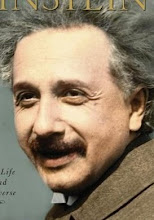
And remember the Einstein Thought For the Day earlier this week: "Mass and energy are both but different manifestations of the same thing - a somewhat unfamiliar conception for the average mind."
I have a problem with the disdainful discussion of "creationists" by the intelligentsia who generally seem to favor the evolutionists as being more aligned with science and therefore reality. I don't think it's either one, really, because I believe in eternity. I believe in a light shining in the darkness,I believe in birth and death, in regeneration and flux. I accept the laws of thermodynamics: that all beings seek equilibrium and that equilibrium is achieved only in death. I believe we are born again and again, and that some people are old souls heading towards enlightenment, and that then they'll start all over again. I love the Hindu and Buddhist texts that talk about endless ages and intoxicatingly large expanses of time.
Once again, I admit I may be missing something, because I totally don't understand the issue. I am not a religious nut, not by a long shot. I am not a so-called evangelical. I am not what some would call a gun-toting Bible-belt single-minded zealot. I do believe that species adapt and evolve. God knows when I take out the family Bible and look at photos of my great-great grandparents, so stern and odd, they seem to be a different species altogether. But even a cursory look through a few hundred years on ancestry.com will awaken you to a dim understanding of the huge swells and tides of humanity. We don't need to be evolved from the apes, just from folks trying to make the best of it down through the millennia.
We know, from science, there is world upon world in the universe. Solar system upon solar system, galaxy upon galaxy. When I was a little girl, starting in my very youngest years on earth, my parents and grandparents taught me that God had no beginning and no end, that He lived forever and ever and ever. And as we lay in summer fields I learned: same with the stars in the sky- no beginning and no end. Even at the age of two or three, I could wrap my head around that, or at least try. And it was a comfort and a thrill to hear or to say "I will love you forever and ever and ever." The thought of eternity comes easy to certain children.I know my children all loved those thoughts.
So if there is forever and ever, world without end, and if, for example, as many Christians affirm weekly in the Apostles Creed, "I believe... in the communion of saints, the foregiveness of sins, the resurrection of the body, and the life everlasting", then why is it so hard to accept that the tide of homo sapiens has been continual throughout time and space? We learned from scientists in Japan and Wisconsin last Fall that skin cells, when mixed with just a few genes, could theoretically be changed into sperm and egg cells. This is a jump but think about it: bits and pieces of you, sloughed off in the shower or your hairbrush or even the grave, could theoretically drift and mingle with the stuff of stars and be reconstituted into you again*. Resurrection of the body, life everlasting, if you will only believe.
Before I send you off to read the Dalai Lama's Thought for the Week, which carries this thinking further, I'll encourage you to watch and listen for three or four minutes, to Claude Jeter and the Swan Silvertones sing "All Things Are Possible If You Will Only Believe."
Dalai Lama Quote of the Week
"As to what might be the mechanism through which karma plays a causal role in the evolution of sentience, I find helpful some of the explanations given in the Vajrayana traditions, often referred to by modern writers as esoteric Buddhism. According to the Guhyasamaja tantra, a principal tradition within Vajrayana Buddhism, at the most fundamental level, no absolute division can be made between mind and matter. Matter in its subtlest form is prana, a vital energy which is inseparable from consciousness. These two are different aspects of an indivisible reality. Prana is the aspect of mobility, dynamism, and cohesion, while consciousness is the aspect of cognition and the capacity for reflective thinking. So according to the Guhyasamaja tantra, when a world system comes into being, we are witnessing the play of this energy and consciousness reality.
...Despite the success of the Darwinian narrative, I do not believe that all the elements of the story are in place. To begin with, although Darwin's theory gives a coherent account of the development of life on this planet and the various principles underlying it, such as natural selection, I am not persuaded that it answers the fundamental question of the origin of life. Darwin himself, I gather, did not see this as an issue. Furthermore, there appears to be a certain circularity in the notion of "survival of the fittest." The theory of natural selection maintains that, of the random mutations that occur in the genes of a given species, those that promote the greatest chance of survival are most likely to succeed. However, the only way this hypothesis can be verified is to observe the characteristics of those mutations that have survived. So in a sense, we are stating simply this: "Because these genetic mutations have survived, they are the ones that had the greatest chance of survival."
From the Buddhist perspective, the idea of these mutations being purely random events is deeply unsatisfying for a theory that purports to explain the origin of life. ...One empirical problem in Darwinism's focus on the competitive survival of individuals, which is defined in terms of an organism's struggle for individual reproductive success, has consistently been how to explain altruism, whether in the sense of collaborative behavior, such as food sharing or conflict resolution among animals like chimpanzees or acts of self-sacrifice. There are many examples, not only among human beings but among other species as well, of individuals who put themselves in danger to save others.
...From the scientific view, the theory of karma may be a metaphysical assumption--but it is no more so than the assumption that all of life is material and originated out of pure chance."
--from The Universe in a Single Atom: Convergence of Science and Spirituality by H.H. the Dalai Lama
*see http://thehurlyburly.blogspot.com/2007/11/stem-cell-revelations-and-eternal-life.html
And remember the Einstein Thought For the Day earlier this week: "Mass and energy are both but different manifestations of the same thing - a somewhat unfamiliar conception for the average mind."
Subscribe to:
Posts (Atom)