I was sitting in my beautiful marble and tile bathroom, for the very simplest of reasons, and, lost in thought, I put my head in my hands and rubbed my hands through my hair and across my forehead and temples. I became alarmed when I discerned I had a fever, like hot coals, but only in the pre-frontal lobe, and only on the right side, near the temple. That area was very hot, seemingly inflamed. I ran to the computer and searched. Wikipedia, for what it's worth, told me this:
"The most typical neurologic term for functions carried out by the pre-frontal cortex area is executive function. Executive function relates to abilities to differentiate among conflicting thoughts, determine good and bad, better and best, same and different, future consequences of current activities, working toward a defined goal, prediction of outcomes, expectation based on actions, and social "control" (the ability to suppress urges that, if not suppressed, could lead to socially-unacceptable outcomes)".
Naturally we don't want to devolve into anything crumpled up and tortured, and we won't. When we Boomers suspect that our kids have started salivating at the thought of having us declared non compos mentis, it does give us a little boost, gotta pick up our heels. I realize, of course, that the current political situation has driven my prefrontal cortex to the brink of something from "Mission Impossible": "This tape will self-destruct in twenty seconds." I mean how much more can a sane person take? And, uh, what was that mission we were supposed to do, again? Oops too late. Brain's shorting out and getting hot in spots. But hold your horses kiddies, it's just a short, and there are boxes of new fuses down in the basement.
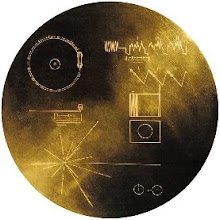
This Boomer generation, so well-intended, didn't get in on the inside track to save mankind, which is where we thought we were going for awhile, but we did ok. Like every generation of warriors before us, we too, like Odysseus, grow old and feeble, and die. Imagine Timothy Leary's ashes, by his directive, shot from some cannon into space orbit, his own little psychedelic redemption. Carl Sagan tried his best to legitimize some of his most far-flung thoughts, and helped NASA send out that Voyager Golden Record depicting our status here on earth. Aldous Huxley thought about it....he was right, we got our Soma, aka Prozac, and we became the Prozac Nation. But we still weren't saved. Who would have thought that some spaceship or some drug wouldn't have come along and rescued us by now?
I like to think at times of John F Kennedy, with his eternal flame at Arlington, fluttering at times, and Jacqueline, her dignified bones beside him, but then what? Then I remember Joe DiMaggio sending roses daily to Marilyn Monroe's grave. And Happy Birthday, Mr. President, courtesy of Jean-Louis couture.
I think of the poets and the playwrights, Shakespeare, Eliot and Yeats and so many more, who seemed so transcendent in my youth,and then I think, or rather I know with great sadness, that fewer and fewer people read and will be educated in such a way that these writers will ever matter again.
And what about our achievements in terms of perfecting the human body, those who have strived to reach the highest levels of physical aptitude? Well then I think about poor Marion Jones in jail. I read this week's Economist and am reminded of the Olympics in Mexico City 1968, Munich 1972, and what may yet happen in Beijing 2008.
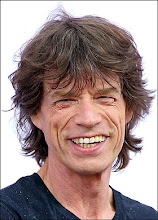
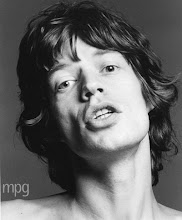
We're just like any other athletes, dying young. Well. Younger than we thought we would, considering we thought we were immortal. The Rolling Stones are one of our best stabs at Boomer holiness, they will go on and teach the younger generations what it is to grow old, and what it can be, physically at least. Mick will strut and fret his hours upon the stage, and outdo all others. He'll be irreverent. He'll break rules and keep some. We can't hope for a whole lot more, out of the ashes of our generation's youth, than what old Mick Jagger does, and did. That's exaggerated, but he made people happy and brought them together. Martin Scorcese says the Stones' music helped him him through many a troubled time, and Scorcese will honor them with his upcoming movie.
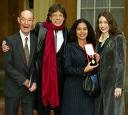
Mick Jagger honored his father, took him along to Buckingham Palace when he became Sir Mick Jagger. He may have coveted and adulterated a wife or two, but he didn't kill anyone. That's at least a few of the Ten Commandments. He's got an awful lot of energy, it's got to count for something good. I wish I had it. This little flame on the side of my head feels a little better when I think of Mick Jagger. Which figures, since that side is associated with recall of music and art, albeit, if lesions, then losses.
So I rub the side of my head and wonder what's going to go next. No worries about the impulse to perform socially unacceptable acts, or to form new longterm memories worth acting upon, never mind, that's on the other side. I had a killer fever there long long ago. Next to go will be remembering who-the-heck-are the Rolling Stones.
My Master's in Psychology sticks with me enough that I know none of this temple rubbing and frontal lobe localized fever-stuff is really true. But it's fun to speculate about. Like old Heads used to do.
I'll just sit here and wait it all out. Luckily I don't mind playing solitaire.
~~~~~~~~~~~~~~~~~~~~~~~~~~~~~~~~~~~~~~~~
And for those who didn't make it:
"To an Athlete Dying Young" by A. E. Housman
The time you won your town the race
We chaired you through the market-place;
Man and boy stood cheering by,
And home we brought you shoulder-high.
To-day, the road all runners come,
Shoulder-high we bring you home,
And set you at your threshold down,
Townsman of a stiller town.
Smart lad, to slip betimes away
From fields where glory does not stay,
And early though the laurel grows
It withers quicker than the rose.
Eyes the shady night has shut
Cannot see the record cut,
And silence sounds no worse than cheers
After earth has stopped the ears:
Now you will not swell the rout
Of lads that wore their honours out,
Runners whom renown outran
And the name died before the man.
So set, before its echoes fade,
The fleet foot on the sill of shade,
And hold to the low lintel up
The still-defended challenge-cup.
And round that early-laurelled head
Will flock to gaze the strengthless dead,
And find unwithered on its curls
The garland briefer than a girl's.
Showing posts with label Carl Sagan. Show all posts
Showing posts with label Carl Sagan. Show all posts
Sunday, April 27, 2008


Tuesday, November 13, 2007
Feeling Smart: A Bertrand Russell Primer
If you’re anything like me, your bookcase was bejeweled at some point in the last twenty years with a copy of Stephen Hawking’s “A Brief History of Time.” Mine sat around bedside for awhile, then made its way to the coffee table for admiration purposes, and finally to the bookshelf where it is presently covered with ashes from the fireplace, fallen bits of incense and what look to my overactive imagination like they might be bat droppings.
We can all understand why we bought the book. It was affordable and fairly small. The cover photograph was compelling: Stephen Hawking under the stars in his wheelchair, his Einstein-ishness fascinating in the context of his disability. And the eminently user-friendly Carl Sagan wrote an introduction! (You haven’t forgotten him, and that plaque he sent out into the heavens, the Voyager Golden Record, have you?) But above all, we bought the book because it made us feel smart. For a moment, we thought we might actually be able to understand it. Mine looked very good up against my copy of “The World Treasury of Physics, Astronomy, and Mathematics.” And of course, we wanted a little of it to rub off on our kids.
Bertrand Russell, the British philosopher and mathematician who died in 1970 at nearly 100 years old, is just as formidable an intellect as Mr. Hawking, by my simple figuring. And, with all due respect to Mr. Hawking, more so, because he had such broad ranging impact. Russell co-authored “Principia Mathematica” and wrote “History of Western Philosophy.” Above and beyond his achievements in mathematics and philosophy, he was active in opposing the Vietnam War and nuclear armament, and he won the Nobel Prize in Literature in 1950.
His autobiography is a little dry but quite readable. And I assure even the most hesitant reader that you can share, understand and cherish some of this brilliant man’s deepest thoughts, and you'll feel mighty smart when you do. He elevates us with his eloquence. You need only read the following few beautiful paragraphs - the prologue to his autobiography- and I know that you may be moved, as I was, forever. Then add a supersmart book to your library that you can reach for, knowing of a page you can read to the kids.
THE PROLOGUE TO BERTRAND RUSSELL'S AUTOBIOGRAPHY
"WHAT I HAVE LIVED FOR"
“Three passions, simple but overwhelmingly strong, have governed my life: the longing for love, the search for knowledge, and unbearable pity for the suffering of mankind. These passions, like great winds, have blown me hither and thither, in a wayward course, over a great ocean of anguish, reaching to the very verge of despair.
I have sought love, first, because it brings ecstasy - ecstasy so great that I would often have sacrificed all the rest of life for a few hours of this joy. I have sought it, next, because it relieves loneliness--that terrible loneliness in which one shivering consciousness looks over the rim of the world into the cold unfathomable lifeless abyss. I have sought it finally, because in the union of love I have seen, in a mystic miniature, the prefiguring vision of the heaven that saints and poets have imagined. This is what I sought, and though it might seem too good for human life, this is what--at last--I have found.
With equal passion I have sought knowledge. I have wished to understand the hearts of men. I have wished to know why the stars shine. And I have tried to apprehend the Pythagorean power by which number holds sway above the flux. A little of this, but not much, I have achieved.
Love and knowledge, so far as they were possible, led upward toward the heavens. But always pity brought me back to earth. Echoes of cries of pain reverberate in my heart. Children in famine, victims tortured by oppressors, helpless old people a burden to their sons, and the whole world of loneliness, poverty, and pain make a mockery of what human life should be. I long to alleviate this evil, but I cannot, and I too suffer.
This has been my life. I have found it worth living, and would gladly live it again if the chance were offered me.”
-Bertrand Russell
We can all understand why we bought the book. It was affordable and fairly small. The cover photograph was compelling: Stephen Hawking under the stars in his wheelchair, his Einstein-ishness fascinating in the context of his disability. And the eminently user-friendly Carl Sagan wrote an introduction! (You haven’t forgotten him, and that plaque he sent out into the heavens, the Voyager Golden Record, have you?) But above all, we bought the book because it made us feel smart. For a moment, we thought we might actually be able to understand it. Mine looked very good up against my copy of “The World Treasury of Physics, Astronomy, and Mathematics.” And of course, we wanted a little of it to rub off on our kids.
Bertrand Russell, the British philosopher and mathematician who died in 1970 at nearly 100 years old, is just as formidable an intellect as Mr. Hawking, by my simple figuring. And, with all due respect to Mr. Hawking, more so, because he had such broad ranging impact. Russell co-authored “Principia Mathematica” and wrote “History of Western Philosophy.” Above and beyond his achievements in mathematics and philosophy, he was active in opposing the Vietnam War and nuclear armament, and he won the Nobel Prize in Literature in 1950.
His autobiography is a little dry but quite readable. And I assure even the most hesitant reader that you can share, understand and cherish some of this brilliant man’s deepest thoughts, and you'll feel mighty smart when you do. He elevates us with his eloquence. You need only read the following few beautiful paragraphs - the prologue to his autobiography- and I know that you may be moved, as I was, forever. Then add a supersmart book to your library that you can reach for, knowing of a page you can read to the kids.
THE PROLOGUE TO BERTRAND RUSSELL'S AUTOBIOGRAPHY
"WHAT I HAVE LIVED FOR"
“Three passions, simple but overwhelmingly strong, have governed my life: the longing for love, the search for knowledge, and unbearable pity for the suffering of mankind. These passions, like great winds, have blown me hither and thither, in a wayward course, over a great ocean of anguish, reaching to the very verge of despair.
I have sought love, first, because it brings ecstasy - ecstasy so great that I would often have sacrificed all the rest of life for a few hours of this joy. I have sought it, next, because it relieves loneliness--that terrible loneliness in which one shivering consciousness looks over the rim of the world into the cold unfathomable lifeless abyss. I have sought it finally, because in the union of love I have seen, in a mystic miniature, the prefiguring vision of the heaven that saints and poets have imagined. This is what I sought, and though it might seem too good for human life, this is what--at last--I have found.
With equal passion I have sought knowledge. I have wished to understand the hearts of men. I have wished to know why the stars shine. And I have tried to apprehend the Pythagorean power by which number holds sway above the flux. A little of this, but not much, I have achieved.
Love and knowledge, so far as they were possible, led upward toward the heavens. But always pity brought me back to earth. Echoes of cries of pain reverberate in my heart. Children in famine, victims tortured by oppressors, helpless old people a burden to their sons, and the whole world of loneliness, poverty, and pain make a mockery of what human life should be. I long to alleviate this evil, but I cannot, and I too suffer.
This has been my life. I have found it worth living, and would gladly live it again if the chance were offered me.”
-Bertrand Russell
Subscribe to:
Posts (Atom)